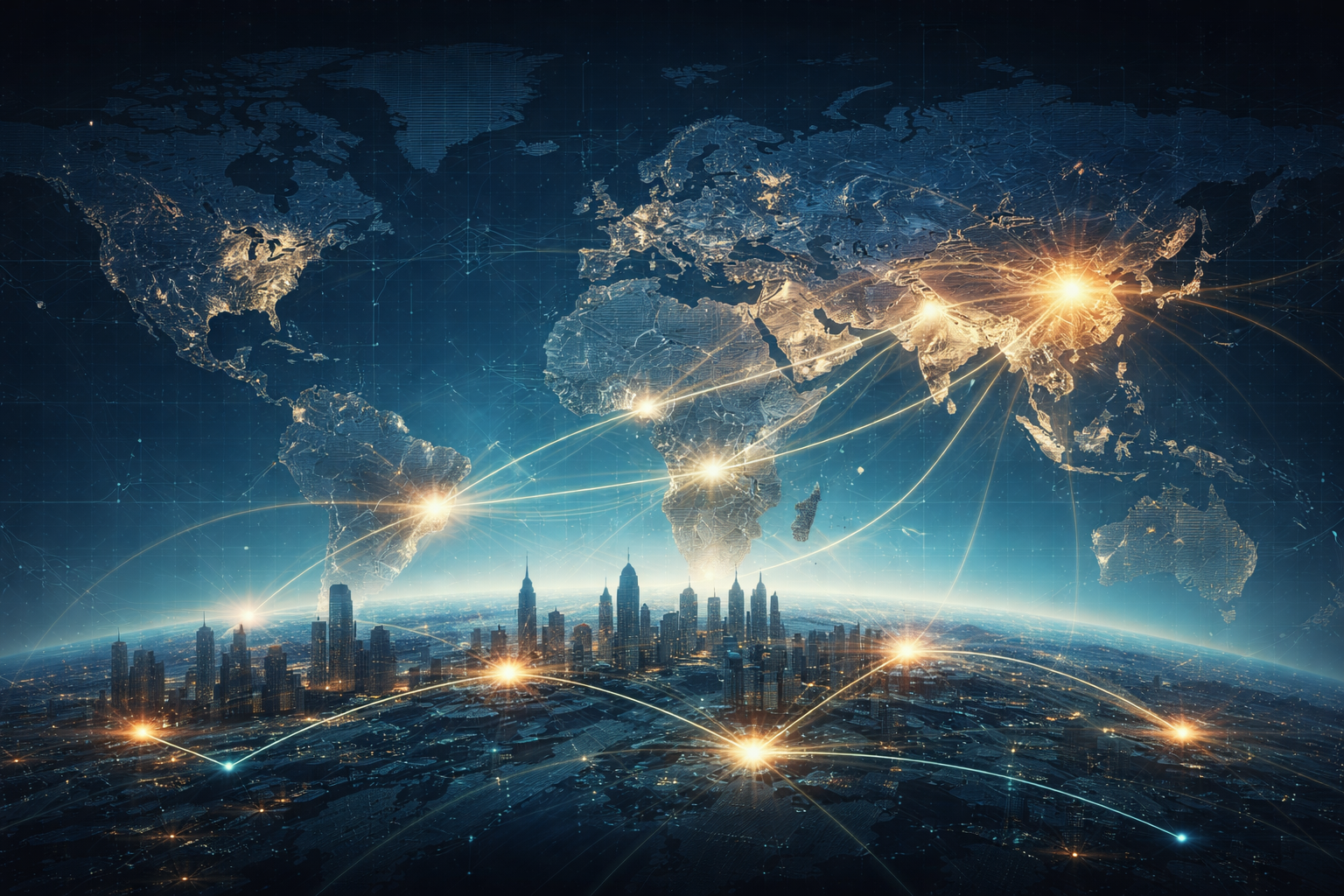
Power shift framing How artificial intelligence is quietly redrawing the map of global power — and why most nations are unprepared for what is already underway.
Ernest Hemingway once wrote that the world breaks everyone — and that those who will not break, it kills. He was writing about individuals. But his observation carries an uncomfortable truth about nations too, particularly in moments when the rules of global power change faster than institutions can adapt.
Throughout history, those changes have always announced themselves. Empires rose visibly, on the backs of armies and the weight of conquest. Industrial revolutions roared their arrival through smokestacks and steam engines. Even the nuclear age declared itself with a blinding flash over the New Mexico desert. Power, in every era, made noise. It wore a uniform, flew a flag, and moved in formation.
What is unfolding today makes no such announcement. Artificial intelligence is not arriving with fanfare or declaration. It is arriving in data centres, in recommendation algorithms, in the automated systems that now quietly shape what people read, what governments decide, which companies survive, and which economies thrive. It is reshaping the foundations of global influence without a treaty, without a press conference, and without the kind of public debate that changes of this magnitude have always previously demanded.
Nations that once measured their standing in armies, oil reserves, and industrial output are discovering that the decisive factor in global influence is shifting toward something far less visible — the capacity to compute, to predict, and to automate human reasoning itself.
The question is no longer simply who has the strongest military or the largest economy. It is who controls intelligence itself — and whether the rest of the world is paying close enough attention to understand what is quietly being decided on their behalf.
How Is AI Reshaping Global Power Today?
The global AI power shift is moving influence away from military strength and territorial control toward data, algorithms, and automated decision-making. Nations and corporations leading in AI development are building compounding advantages in economic output, information reach, and strategic leverage — creating gaps that grow harder to close with every passing year.
From Gunpowder to Algorithms: How Global Power Has Always Shifted
History does not change gradually. It changes in ruptures — long stretches of stability interrupted by a single technological shift that breaks the entire architecture of dominance and forces the world to reorganise around a new logic. Agricultural societies derived power from land. Industrial nations derived it from machines and mass production. The nuclear age redefined power entirely, measuring it not just by what you could build but by the credibility of what you could destroy.
Each transition followed the same recognisable pattern. A new capability emerged, early adopters gained decisive advantages, those advantages compounded, and the gap between those who adapted and those who did not widened until a new global order — shaped entirely by the leaders — became the default condition of international life.
Artificial intelligence fits this pattern precisely, but it differs from every previous power transition in three important ways. First, AI systems improve through use, meaning early leads do not just persist — they accelerate. Second, AI operates at scale without territory — a single platform can reach billions of people across dozens of countries simultaneously without a single physical presence. Third, AI moves faster than governance, making millions of consequential decisions every second, far outpacing any regulatory or democratic process designed to oversee it.
For countries like the United States, the United Kingdom, Australia, Canada, and New Zealand, that third point carries particular weight. Western democratic institutions were built for slow, deliberate transitions with visible thresholds — not for a transformation that reshapes the entire strategic landscape before the policy conversation has properly begun. The countries that adapted fastest to previous power transitions — not always the most powerful at the outset, but the most agile — became the defining forces of the era that followed. The same logic applies today.
Data Is the New Geography: Why Digital Territory Now Defines Power
For most of recorded history, geography was destiny. Nations with natural harbours controlled trade, nations with defensible borders survived longer, and nations sitting atop oil reserves accumulated wealth that translated directly into global influence. Physical location told you almost everything about where power lived.
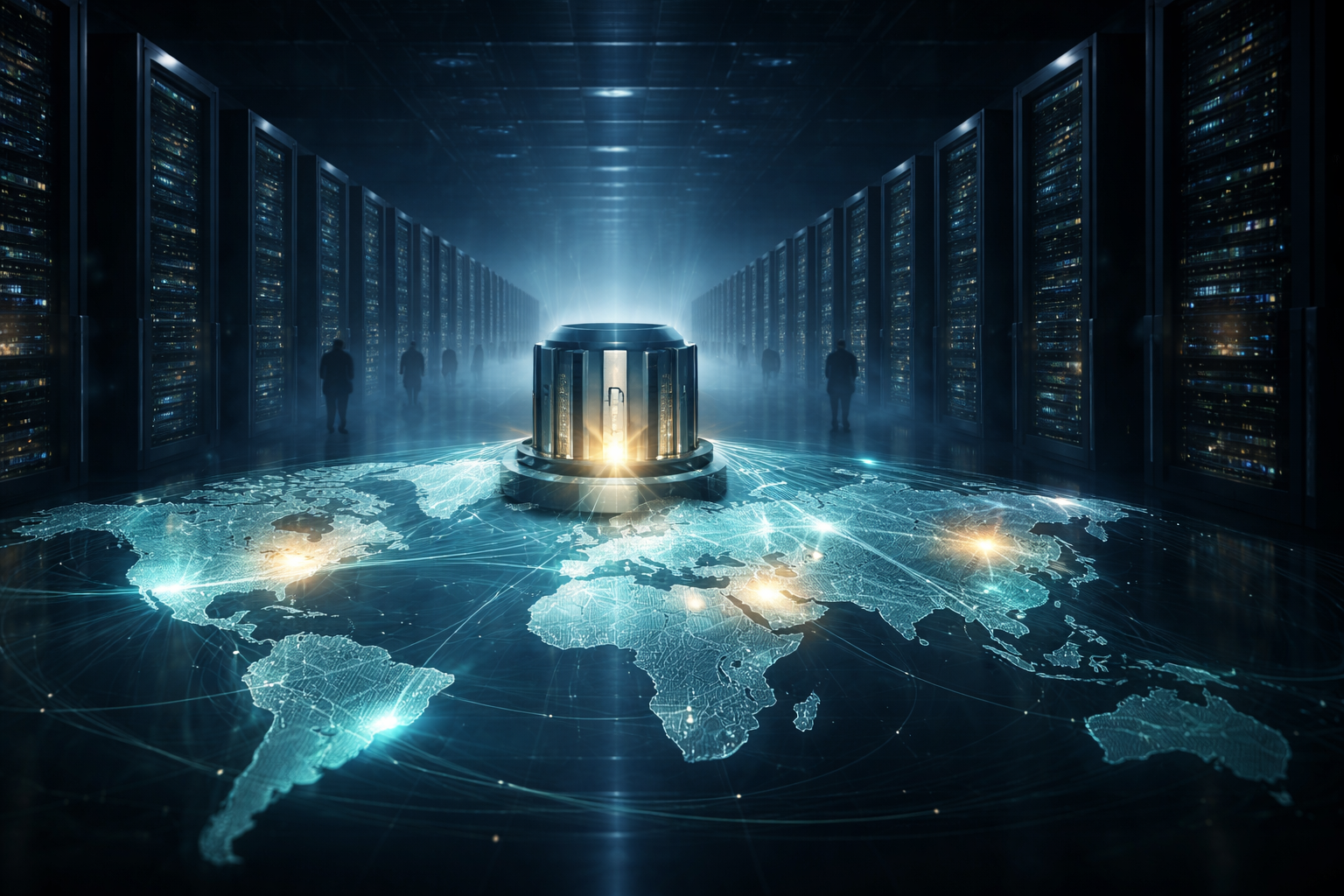
That logic has not disappeared, but it is being fundamentally surpassed by a different kind of geography. The most strategically significant territory in the world today is not measured in square kilometres — it is measured in petabytes. Data centres, cloud infrastructure, and AI training systems have become the new strategic landscape, and the entities that control them exercise a form of dominance far harder to challenge than anything a military force can produce.
Consider what digital sovereignty actually means in practice. A government that stores citizens’ data on foreign cloud infrastructure, relies on foreign AI systems to manage public services, and depends on algorithms trained on foreign data to inform policy decisions is not fully sovereign in any operational sense. It has outsourced the nervous system of its own governance to entities it does not control and may not fully understand. This dynamic — which scholars are calling digital dependency — does not require invasion or occupation. It simply requires structural reliance, and that reliance is already deeply embedded across most of the world.
For smaller democracies — New Zealand, the Nordic countries, the Netherlands, Canada — the practical implications are immediate and real. These are nations with strong governance traditions and genuine democratic values, but none of them are building foundational AI systems at the scale required to avoid dependency on the major AI powers. The honest policy question they face is whether meaningful digital sovereignty is still achievable through regional cooperation and regulatory leverage — or whether the structure of global AI development makes dependency the unavoidable default for any nation outside the top tier.
The Most Important Power Struggle Nobody Is Watching
Here is a question serious analysts are now asking openly. When a decision made by a technology platform affects more people than most governments ever reach, who actually holds the governing authority? The answer is uncomfortable for anyone committed to the idea of democratic self-governance.
The world’s largest AI corporations command research budgets exceeding the total technology spending of most national governments. They employ more AI researchers than most countries have working in the field in any capacity, set the technical standards that governments later struggle to regulate, and make decisions about what information billions of people can access — decisions that are governance in every practical sense, made by entities accountable to shareholders rather than to citizens.
The United States, the United Kingdom, Germany, Australia, and New Zealand have each built significant portions of their global standing on commitments to democratic governance and accountable institutions. Yet each of these nations has, largely without structured public debate, allowed the most consequential governance decisions of the digital era to drift toward corporate entities operating under no democratic mandate. This is not primarily a story of corporate malice. It is a story of institutional speed. Governments that move at legislative pace cannot keep up with platforms that deploy at software pace, and the authority was ceded incrementally and largely unnoticed by institutions too slow to recognise what was being transferred.
The AI Economic Divide: Who Gains and Who Gets Left Behind
The productivity gains from artificial intelligence are visible in aggregate economic data. What is far less visible — and far more consequential — is how unevenly those gains are being distributed across societies and across the global economic order.
Economists describe what is emerging as accelerated skill polarisation. At one end, those who can design, deploy, and work effectively alongside advanced AI are experiencing income and productivity growth that would have seemed extraordinary just a decade ago. At the other end, workers in routine cognitive roles that AI can now perform cheaply and at scale face displacement that is structural rather than cyclical — it will not be corrected by the next economic upturn. The middle ground is where the story becomes most urgent. Knowledge workers in the United States, Canada, the United Kingdom, and Australia who believed their analytical roles were insulated from automation are discovering that AI systems can now perform significant portions of their work faster, cheaper, and more consistently. Legal research, financial modelling, content production, and mid-level management are all experiencing disruption that previous waves of automation left largely untouched.
At the global scale, the divide sharpens further. Nations that develop and deploy AI at scale extract compounding productivity advantages over time, while nations that cannot — due to infrastructure gaps, investment shortfalls, or technical capacity constraints — fall progressively further behind. Japan, South Korea, and Germany are treating AI integration as a defensive economic priority. Nordic countries are coupling AI adoption with social policy frameworks designed to manage labour market transitions. Meanwhile, much of the Global South faces the prospect of being subject to AI systems they did not design, trained on data that does not represent them, and optimising for outcomes defined entirely without their input.
How AI Is Quietly Rewriting Soft Power and Cultural Influence
Marshall McLuhan argued that the medium shapes the message as profoundly as the content itself. He was writing about television, but his insight describes the AI era with far greater precision. When the medium is an algorithm making autonomous decisions about what billions of people see, read, and are recommended daily, the question of who controls that algorithm becomes a question of soft power at civilisational scale.
Soft power has always worked through cultural exports, institutional prestige, and the appeal of values. Hollywood, the BBC, American universities, and the global spread of English were all instruments through which the United States and the United Kingdom shaped global preferences without resorting to force. That influence was real but also visible — audiences knew they were watching an American film or reading British journalism. AI-generated content works differently. News articles, creative works, educational materials, and information summaries now emerge from systems whose cultural assumptions and embedded values are largely invisible to the people consuming them. The question of whose perspective shapes AI output is no longer primarily editorial — it is technical, determined by training data composition and choices made by a very small number of engineers at a very small number of companies.
When leading AI systems are trained predominantly on English-language, Western-cultural data and their output is consumed globally, the result is not diversity of perspective. It is a quiet, structural pressure toward a particular set of assumptions about human life and value — soft power without a face, narrative influence without a narrator, and cultural leverage at a scale no previous medium has approached.
The Turning Point: When AI Governance Becomes a Matter of Democratic Survival
For several years, the dominant framing of AI governance was purely regulatory — which rules apply to which technologies to prevent specific harms. That framing was not wrong, but it has been overtaken by a far more fundamental challenge. The question is no longer only what rules AI should operate under. It is whether existing democratic institutions are structurally capable of governing AI at all, given the speed and opacity at which it now operates.
Democracy was designed for a world that moved at human speed. Its mechanisms — elections, legislative debate, judicial review, public deliberation — were built on the assumption that consequential decisions could be identified, examined, and subjected to accountable oversight before their effects became irreversible. AI operates on a completely different temporal logic, making millions of consequential decisions every second, many of them technically opaque even to experts. The institutional capacity required to understand, evaluate, and oversee those decisions does not yet exist in any democratic government at the scale required.
This creates an asymmetry that is particularly sharp between democratic and authoritarian governance models. Authoritarian states — China being the most significant example — can deploy AI surveillance, influence operations, and economic strategy without the transparency requirements that democratic governance demands. That asymmetry does not vindicate authoritarianism, but it does mean democracies must urgently build governance frameworks capable of operating at AI speed without sacrificing the values that make democratic governance worth defending. The European Union’s AI Act is the most comprehensive attempt by a major democracy to build such a framework, and its effects are already visible in how global AI companies adjust their products for European markets. The United States, the United Kingdom, Australia, and Canada are each navigating the tension between regulatory caution and the risk of falling further behind in a race where the leaders are already writing the rules.
Key Insights
- The global AI power shift is concentrating advantage in a very small number of nations and corporations — and that advantage compounds with every passing year.
- Digital dependency — relying on foreign AI infrastructure for core national functions — erodes sovereignty without requiring a single act of military force.
- Economic disruption from AI is hitting hardest in the cognitive middle, across the US, UK, Australia, Canada, and comparable Western economies.
- Soft power in the AI era operates through algorithmic systems whose cultural assumptions remain largely invisible to the billions of people they influence daily.
- Democratic governance faces a structural speed mismatch with AI decision-making that no existing regulatory framework has yet adequately resolved.
Frequently Asked Questions About the Global AI Power Shift
Which countries are leading the global AI power race?
The United States and China hold the most significant leads, commanding the largest concentrations of AI research talent, computational infrastructure, and proprietary data. The European Union is a major regulatory force shaping AI development within its jurisdiction. The UK, Canada, Israel, and South Korea maintain notable research capabilities. For most other nations — including otherwise stable and prosperous democracies — the realistic position is strategic dependency rather than competitive leadership.
How does the AI power shift affect smaller nations like New Zealand?
Smaller nations face growing digital dependency as their public services, financial infrastructure, and information environments become reliant on AI systems built and controlled elsewhere. This constrains practical autonomy in ways that matter enormously. Regional cooperation, domestic AI investment, and regulatory leverage — as the EU has demonstrated — are the main tools available to smaller nations seeking to manage this reality effectively.
Is AI a bigger threat to democracy than social media was?
AI presents a qualitatively different challenge to democracy than social media did. Social media amplified human-created content and accelerated polarisation. AI can generate highly targeted political messaging at scale, shape information environments autonomously, and assume governance functions previously held by accountable human institutions — creating oversight challenges that social media, disruptive as it was, did not produce at the same structural level.
Can developing nations benefit from AI or will they fall further behind?
The risk of AI widening global economic inequality is real and well-documented. However, targeted investment in AI literacy, regional data infrastructure, and leapfrog adoption strategies — similar to mobile banking adoption across parts of Africa — offer genuine pathways that do not require replicating the full development trajectory of leading nations.
What does the AI power shift mean for jobs across Western economies?
AI will restructure rather than simply eliminate employment across Western economies. Roles built around routine cognitive tasks will transform significantly, and new roles will emerge around AI oversight, integration, and training. The transition will be uneven, with workers in mid-skill cognitive positions facing the steepest adjustment challenges and, in most countries, the least adequate policy support currently available.
Conclusion
Every major transformation in global order has, in retrospect, seemed inevitable. The agricultural revolution, the industrial age, the nuclear era — each appeared, once established, as though it could not have unfolded any other way. The global AI power shift will likely be viewed the same way by generations looking back from a world already shaped by its consequences.
What is less certain is the character of the world that emerges from it. The concentration of AI capability in a small number of national and corporate actors is producing a reordering of global influence as significant as any in modern history — but without the visible drama that would otherwise force broad public deliberation. No declaration of war marks its progress. No peace treaty will signal its resolution.
The transitions that produced the most durable outcomes in history were not always the fastest ones. They were the ones that built the broadest institutional foundations as they moved. Whether that lesson applies to the AI power shift — whether institutional capacity can genuinely keep pace with capability — remains an open question being shaped right now by choices that governments, corporations, and societies are making largely without the public deliberation that decisions of this magnitude deserve.
Perhaps the most consequential shifts are never the ones that arrive with headlines. They are the ones quietly rewriting the rules by which the world works — long before the world has agreed on what those rules should be.
Global Transformation Magazine Decoding Today’s Trends, Navigating Tomorrow.
Part of our Global Trends and Transformation series — analytical perspectives on the forces reshaping the twenty-first century world.