More wellness tools, higher stress rates — why the industry built around women’s wellbeing may be the thing undermining it.
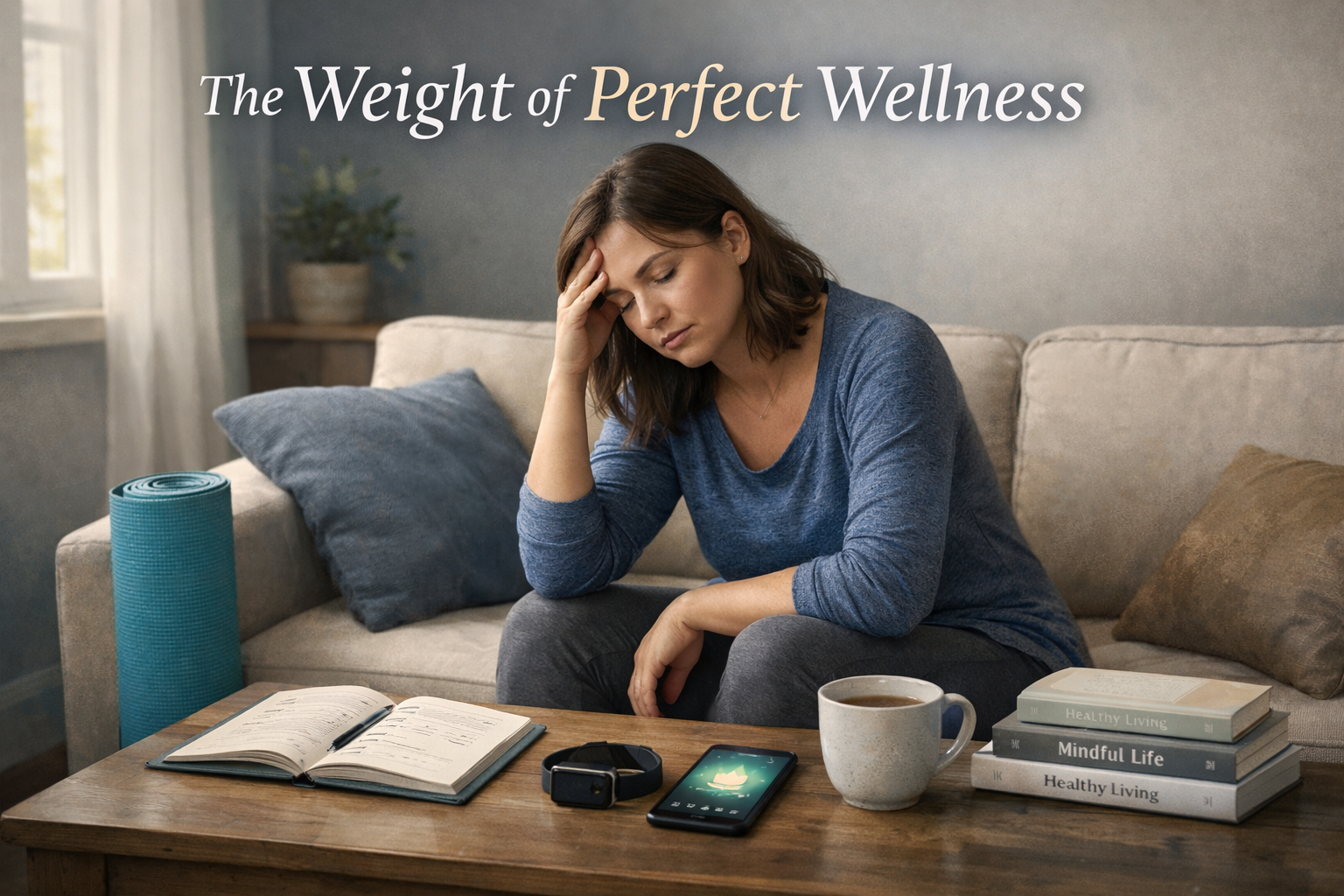
Somewhere along the way, the idea of taking care of yourself quietly became another job. Pick up any women’s magazine, scroll through any wellness feed, or browse the self-help aisle in a bookstore from New York to Auckland, and you will find the same message dressed in a thousand different outfits: you could be better. Sleep better. Eat cleaner. Think more clearly. Process your emotions more efficiently. Track, optimise, improve.
In The Feminine Mystique, Betty Friedan described a “problem that has no name” — a widespread but unspoken dissatisfaction running beneath the surface of women’s lives. Decades later, a new version of that problem is taking shape. It doesn’t look like oppression from the outside. It looks like a morning routine. It looks like a wellness app. It looks, in every way, like care.
Women across the United States, the United Kingdom, Australia, Germany, and New Zealand now have access to more wellness resources than any generation before them. Therapy apps, mindfulness platforms, fitness trackers, sleep scores, habit-stacking tools — all of it available, affordable, and relentlessly encouraging. And yet, despite this extraordinary abundance, women’s reported rates of stress, burnout, and emotional exhaustion continue to climb.
That gap between effort and outcome is worth pausing on. More wellness is not producing more wellbeing. In fact, for millions of women, the pursuit of wellness has quietly become one of the heaviest things they carry. The wellness industry burnout that researchers are now documenting is not a fringe experience — it is a pattern that cuts across age groups, income levels, and geographies.
So what went wrong — and what does genuinely restorative self-care actually look like when you strip away the industry around it?
Why Is Wellness Culture Making Women More Stressed Instead of Healthier?
Modern wellness culture has turned self-care into a system of continuous self-improvement rather than genuine rest. Women are expected to monitor their bodies, emotions, sleep, and productivity against an ever-rising standard — one that never reaches a finish line. This sustained pressure activates perfectionist thinking, which research consistently links to higher rates of anxiety, depression, and emotional exhaustion rather than improved wellbeing.
From Rest to Performance: How Wellness Lost Its Original Meaning
The wellness movement did not begin as a system of self-correction. Its roots were grounded in something far simpler: rest, prevention, and listening to the body. To be well, in its original sense, meant knowing when to slow down. It meant balance, not optimisation.
That meaning changed gradually, and the shift was so smooth that most people never noticed it happening. The language of productivity — the same language that governed offices and boardrooms — was absorbed into the conversation around health. Steps needed counting. Sleep needed scoring. Emotions needed processing on schedule. What had once been restorative became quantifiable, and what could be quantified could always be improved upon.
Social media accelerated the transformation. Platforms normalised the public display of wellness practices, turning private acts of rest into shareable achievements. Fitness metrics, habit-tracking streaks, and sleep scores created the appearance of control — but they also embedded a culture of continuous self-monitoring into the fabric of daily life. The body was no longer somewhere you lived. It was a project you managed.
This shift reflects something broader in Western culture — a deep distrust of anything that cannot be measured. In a society that values output, stillness starts to feel like failure. And once stillness feels like failure, even rest becomes something to justify.
In New Zealand, the UK, and across the Nordic countries, cultural conversations around wellbeing have tried to push back against this tide. But even in societies with stronger social safety nets and more protected leisure time, the internalised pressure to optimise does not simply disappear. It follows women into their weekends, their holidays, and their supposedly quiet evenings at home.
At the same time, the commercial wellness industry grew into one of the most profitable sectors on earth — worth well over four trillion dollars globally. An industry that large does not thrive on resolution. It thrives on ongoing engagement. And ongoing engagement, by definition, requires that something always remain incomplete.
The Hidden Psychological Cost of Never Being Enough
Beneath the motivational language of “becoming your best self” lies a more uncomfortable psychological reality: when improvement has no endpoint, neither does dissatisfaction.
Researchers studying perfectionism in Western populations have documented a significant rise in self-critical thinking over recent decades. Women consistently report higher levels of internalised standards and harsher self-judgement than men. A 2018 study published in the Journal of Personality found that perfectionist tendencies correlated strongly with rising rates of anxiety and depression, particularly among younger women who had grown up immersed in social media culture.
The hedonic treadmill compounds this problem in a way that feels almost cruel. When one fitness goal is reached, a new one appears. When a mental health milestone is achieved, the baseline quietly resets. The sense of arrival that was supposed to come with all this effort simply never materialises — only the next target, slightly out of reach.
Perhaps the most damaging element is what psychologists call conditional self-worth: the deeply held belief that one’s value depends on recent performance, visible improvement, or measurable achievement. A woman who rests without purpose — who spends an afternoon doing nothing in particular, or who skips her journalling practice — can feel, within this framework, as though she is failing. Not because she has done anything wrong. But because the system she has internalised has redefined stillness as stagnation.
A 2020 study in Frontiers in Psychology found that sustained self-optimisation practices were linked not to greater resilience, but to increased emotional exhaustion and reduced psychological recovery. In other words, the tools designed to help were generating the very fatigue they promised to cure.
Meanwhile, the message from wellness culture remains unchanged: if you are still struggling, you simply haven’t found the right programme yet. This cycle — struggle, invest, repeat — is precisely what keeps women stressed and searching rather than genuinely rested and restored.
The Uncomfortable Truth: Wellness Culture Was Never Really Designed for Women’s Wellbeing
Here is the part that the industry rarely advertises: the mainstream wellness model is not built around resolution. It is built around retention.
The philosopher Byung-Chul Han describes contemporary Western societies as “achievement societies” — cultures where external authority has been replaced by internal pressure. Women are no longer simply told to improve by outside voices. They have internalised the demand and are driving it themselves, becoming simultaneously the worker and the taskmaster. This makes the pressure extraordinarily difficult to escape, because it doesn’t feel like pressure from the outside. It feels like personal motivation.
Author Barbara Ehrenreich, in Bright-Sided, argued that the wellness industry’s insistence on positivity frequently suppresses genuine distress by reframing struggle as personal failure. When anxiety persists, the logic runs, the solution is not to examine its causes but to invest in a better programme. To try harder. To upgrade the app.
Tracking apps and self-monitoring tools are most profitable when they convert insecurity into ongoing engagement. Visible effort — logging, measuring, posting — is consistently rewarded. Quiet contentment is invisible and therefore worthless to the algorithm. Women’s mental health, in this commercial framing, is not a destination to be reached but a deficit to be perpetually managed.
This has produced a peculiar cultural outcome: women who are more literate about their wellbeing than any generation before them, and yet more exhausted. Women who can articulate their stress responses, name their attachment styles, and track their sleep cycles — and who still cannot find the time, or the permission, simply to rest.
Across Germany, Australia, and Canada, researchers have noted similar patterns. The vocabulary of self-care has expanded dramatically. The actual experience of feeling cared for has not kept pace.
Why Women Carry the Heaviest Load in Wellness Culture
The pressure to optimise touches everyone, but women carry a disproportionate share of its weight — and this is not accidental. It is the product of long-standing cultural expectations dressed in new, therapeutic language.
“Doing the inner work” has shifted from a therapeutic tool available to anyone into a social obligation that applies almost exclusively to women. In many communities, women are expected to be perpetually healing, processing, or growing. To not be actively working on yourself is read as complacency — or worse, as selfishness.
Emotional labour adds another dimension that is rarely named honestly in wellness spaces. Women are widely expected to manage not only their own emotions but the emotional climate of everyone around them — at home, in the workplace, and increasingly online. Anxiety, irritability, or simple tiredness are not read as normal human fluctuations. They become evidence of insufficient mindfulness, or an inadequately managed inner state.
Sociologist Eva Illouz describes how inner states that were once private are now structured and managed according to market principles. Emotions are evaluated and optimised rather than simply experienced. Wellness trains women to continuously audit their own inner lives — and to experience that auditing as an act of care.
The moralisation of health choices adds yet another burden. In contemporary wellness culture, food and exercise are frequently framed in ethical terms — “clean” versus “dirty” eating, “discipline” versus “laziness.” What a woman puts on her plate has become, in this framing, a statement about who she is as a person.
The Joy Paradox: Why Chasing Happiness Makes It Harder to Find
Wellness culture promises that with the right data, the right systems, and the right routines, wellbeing can be engineered on demand. Happiness psychology, however, consistently tells a more humbling story.
The mismatch lies in what joy actually is. Control thrives on precision and measurable outcomes. Joy, by contrast, is typically relational, spontaneous, and unmeasured. It tends to arrive in moments of genuine absorption — when attention is fully present rather than divided between experiencing something and evaluating it.
Research on attention and wellbeing repeatedly finds that positive affect correlates more strongly with present-moment engagement than with conscious self-monitoring. The very act of tracking joy can interrupt it. As control expands, presence contracts. This is the quiet irony at the centre of modern self-optimisation culture: the more systematically women pursue feeling better, the more the feeling itself recedes.
Research on sustained life satisfaction — conducted across the United States, the UK, Scandinavia, and New Zealand — consistently points to the same things:
- Strong social connection
- A sense of meaning
- The freedom to rest without guilt
- Enough stability to feel safe
None of these appear on a wellness dashboard.
How Social Media Turned Wellbeing Into a Performance
Social media has done something quietly profound to the way women experience their own health: it made it public.
What was once an intimate relationship between a woman and her own body has become, increasingly, a presentation. Social comparison theory tells us that people evaluate themselves relative to others — and social media provides an endless, algorithmically curated supply of comparison targets.
Disciplined mornings, balanced meals, peaceful evening routines — these are presented not as aspirational ideals but as the apparent norm. The gap between this polished presentation and the actual texture of real life is rarely acknowledged, and almost never goes viral.
Algorithms reinforce the pattern. Content demonstrating visible discipline and measurable progress earns reach. This gradually narrows what “healthy” is permitted to look like. Wellness becomes identity performance — something that must be consistently displayed to maintain social credibility.
Women become less attuned to their own internal signals and more dependent on external feedback to gauge how they are doing. Resting states, ambiguous feelings, and fluctuating energy — the ordinary texture of real human experience — go largely unvalidated. The social media wellness comparison trap is not a side effect of these platforms. It is, in many ways, their central feature.
The result is a baseline that never stabilises. There is always a more sophisticated morning routine ahead, a more serene version of wellbeing just out of reach. The comparison target moves. It always moves.
What Real Self-Care Actually Looks Like — Without the Upgrade Cycle
Genuine psychological wellbeing, as research increasingly shows, is not characterised by relentless upward progression. It is characterised by stability, coherence, and adaptability — a meaningful departure from the upgrade narrative.
The concept of permission to plateau offers a useful reframe. A plateau is not stagnation. It is integration. When there is no visible improvement to report, cognitive and emotional systems have space to consolidate, recover, and recalibrate. Consistency itself may be a sign of health, not its absence. Real self-care without the wellness industry’s upgrade cycle looks, in practice, far quieter and far less marketable than what fills most feeds.
Acceptance of emotional variation is equally central. Fluctuations in energy, mood, and motivation are not flaws in the system — they are features of a fully functioning human being. Resilience, research shows, correlates with emotional flexibility, not emotional control.
Non-performative care — tending to oneself in ways that are untracked, undisplayed, and unmeasured — is perhaps the quietest and most powerful shift available. When care is not subject to comparison, attention can return to internal signals rather than external standards.
A 2021 review in Health Psychology Review confirmed that self-tracking tools can drive behavioural change, but produce little evidence of improved happiness. Measurement and emotional fulfilment are distinct outcomes — and consistently focusing on the former can actively diminish the latter.
Sustainable wellbeing tends to look far less dramatic than its commercialised counterpart. It looks like rest without justification. Like a conversation that goes nowhere in particular. Like an afternoon that produces nothing except the experience of having lived through it.
Frequently Asked Questions
What is wellness culture and why is it burning women out?
Wellness culture is a broad commercial and social movement promoting self-improvement through health, fitness, and mental wellbeing practices. It contributes to burnout in women by replacing genuine rest with continuous self-monitoring, perfectionist standards, and performance-driven self-care that generates pressure rather than recovery.
Why do women carry a greater burden in wellness culture than men?
Cultural expectations position women as primarily responsible for emotional labour — managing their own wellbeing and the emotional climate of those around them. Wellness culture reinforces this by framing self-improvement as a social obligation specific to women, adding a layer of pressure that men are far less routinely subjected to.
Does self-tracking actually improve mental health and wellbeing?
Research indicates that self-tracking tools can support behavioural change but show little evidence of improving happiness or emotional fulfilment. A 2021 review in Health Psychology Review found that measurement and wellbeing are distinct outcomes, and that sustained focus on tracking can actively reduce psychological recovery rather than support it.
How does social media make wellness culture more damaging?
Social media converts private self-care into public performance, creating algorithmically curated comparison targets that present disciplined, optimised lifestyles as the norm. This drives women away from internal signals and toward external validation, while narrowing the definition of what “healthy” is permitted to look like.
What does genuine self-care look like without the wellness industry?
Research across multiple countries consistently identifies strong social connection, a sense of meaning, freedom to rest without guilt, and basic stability as the primary drivers of lasting wellbeing. None of these require tracking, optimisation, or commercial products. Genuine self-care tends to be unperformed, unmeasured, and largely invisible by wellness culture’s standards.
Is the wellness industry designed to solve women’s health problems?
The commercial wellness industry is structurally built around ongoing engagement rather than resolution. Retention — not recovery — drives profitability. This means the industry has a financial incentive to keep women engaged with self-improvement rather than arriving at a stable sense of enoughness.
Key Insights
- The global wellness industry, valued at over four trillion dollars, is commercially dependent on ongoing engagement rather than resolution — making perpetual dissatisfaction a structural feature, not a side effect.
- Women across the United States, United Kingdom, Australia, Germany, Canada, and New Zealand report rising rates of stress and burnout despite significantly increased access to wellness resources.
- Research consistently links sustained self-optimisation practices to increased emotional exhaustion rather than improved resilience, across multiple Western populations.
- Social comparison mechanisms built into digital platforms systematically narrow the definition of acceptable health behaviours, increasing pressure while reducing internal attunement.
- Long-term life satisfaction research across the US, UK, Scandinavia, and New Zealand points consistently to social connection, meaning, rest, and stability — none of which are products wellness culture can monetise.
The Bigger Picture: Wellbeing as a Global Conversation
Across the United States, the UK, Australia, Canada, Germany, New Zealand, and beyond, women are navigating a cultural moment in which the tools of self-care and the demands of self-surveillance have become nearly indistinguishable. The vocabulary of wellbeing has expanded. The actual experience of feeling genuinely well has not kept pace.
Research across multiple countries points toward the same quiet conclusion: what generates lasting wellbeing is not a better system of self-management. It is safety, connection, meaning, and the freedom to exist without continuous evaluation. These things are not products. They cannot be tracked. They do not generate content.
The psychological concept of enoughness offers a different orientation entirely. To feel enough is not complacency. It is to exist in a state where the self is not under continuous scrutiny — where an ordinary afternoon does not need to justify itself through measurable output. Studies consistently link this sense of sufficiency to greater life satisfaction and genuine resilience — the kind that does not require an app to sustain.
Perhaps the most important shift is not about finding better practices. It is about questioning the premise that a practice is always required. Joy does not respond well to direct pursuit. It tends to arrive not through effort but through presence — in moments of absorption, connection, and unmeasured experience. When life is finally allowed to be lived rather than managed, something changes. The noise quiets. And in that quiet, something closer to actual wellness becomes possible.
Global Transformation Magazine — Decoding Today’s Trends, Navigating Tomorrow.
Part of the Evolving Womanhood series — clear-eyed perspectives on the shifts, systems, and decisions that women today are navigating, and the world they are building for the daughters who come after them.