
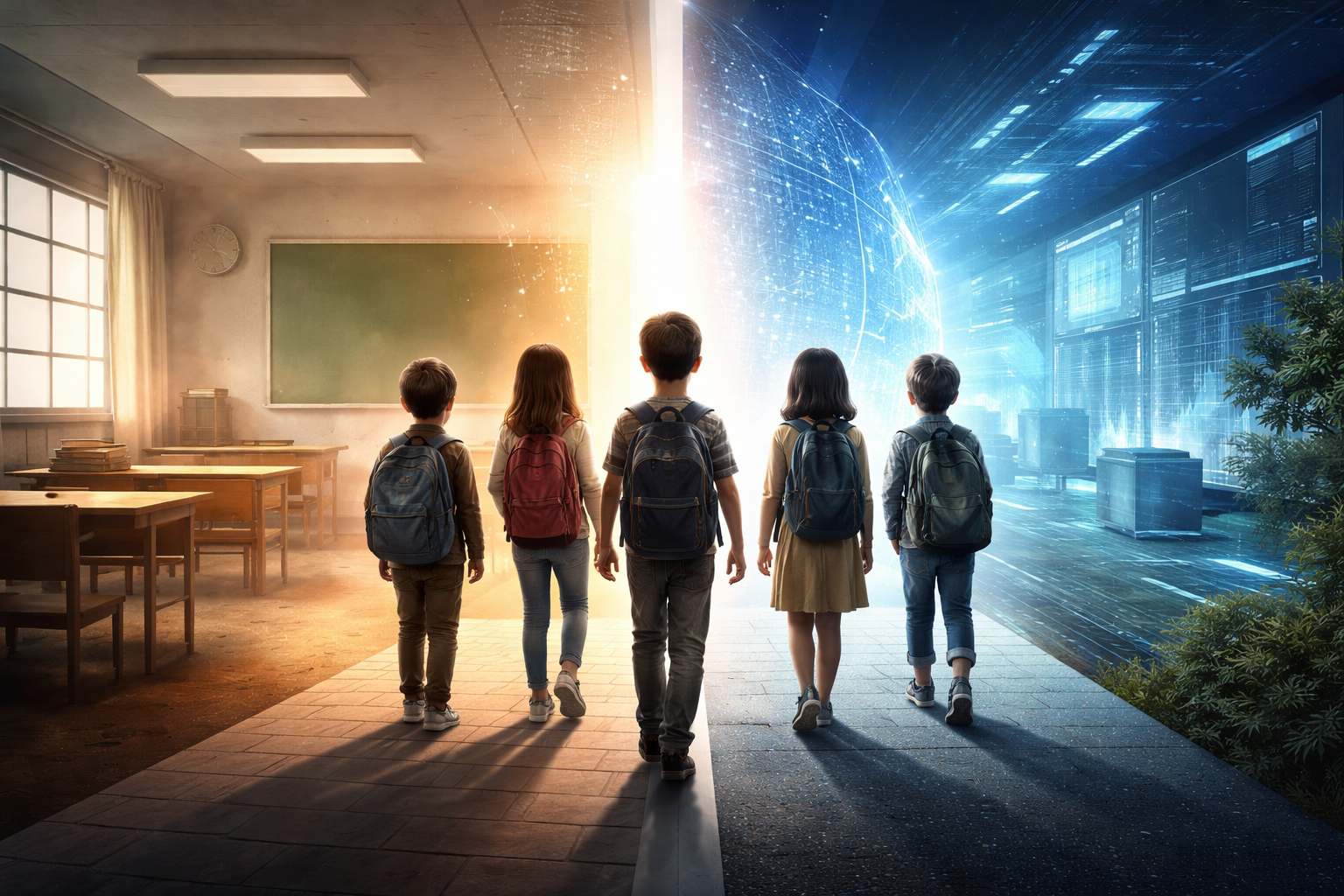
AI is already reshaping hiring, healthcare, and creative industries globally — and research shows the skills children actually need are not what most schools are teaching.

“Give me a fish and I eat for a day. Teach me to fish and I eat for a lifetime.” That old proverb has guided education for generations. But today, something more unsettling is happening — the river itself is changing course.
Artificial intelligence is no longer a distant idea being debated in technology conferences. It is already embedded in hiring platforms, healthcare systems, creative industries, and personalised learning tools across America, Western Europe, Australia, and New Zealand. It has arrived quietly, and it is moving fast.
Most education systems, however, were built for a different era entirely. The structure of standardised tests, age-based grade levels, and lessons centred on memorisation reflects the needs of an industrial economy — one that is rapidly giving way to something new. The World Economic Forum and the OECD have both flagged the same uncomfortable reality: a large share of children entering school today will eventually work in roles that do not yet exist.
Meanwhile, the gap between what schools are teaching and what the future will actually require keeps widening — faster than policy can respond, faster than curriculum can adapt, and faster than most families realise. The world is shifting beneath the feet of a generation still sitting in classrooms designed for the one before it.
What skills do children need for an AI-driven future in education?
Children need critical thinking, emotional intelligence, adaptability, ethical reasoning, and creative problem-solving. These are capabilities AI cannot replicate. In an AI-integrated workforce, these human skills are the core of long-term employability — and the foundations are built in early childhood, not in a classroom at sixteen.
How AI Is Already Reshaping the Global Workforce
It is easy to think of AI as something that will transform work in the future. The reality is that this transformation is already well underway — and it looks different from what most people imagined.
In the United States, AI assists radiologists with medical imaging, screens job applications before a human recruiter ever sees them, and manages supply chains at a level of complexity no human team could handle alone. In Germany and the Czech Republic, smart factories use predictive systems that have replaced large-scale manual oversight. In the Netherlands and Denmark, data-driven tools now support urban planning and public policy delivery.
Across Asia, the adoption curve is just as steep. South Korea and Japan have integrated AI into elder care and advanced manufacturing. Singapore has made AI literacy a national education priority, embedding it into school curricula from early childhood. India is generating AI-adjacent jobs faster than its education system is currently producing qualified candidates — a gap visible across much of Southeast Asia.
New Zealand reflects this shift in its own way. Intelligent systems now manage crop yields, water use, and livestock health in agriculture. Adaptive learning platforms track student progress in real time and adjust content accordingly.
The pattern is consistent across all of these countries: AI is not replacing entire professions so much as it is reshaping what those professions require. Job titles are changing slowly. Job content is changing fast. Workers at every level are now expected to interpret AI outputs, identify when a system is wrong, and make judgement calls that no model can make for them.
That shift places direct pressure on education systems still built around a very different set of assumptions.
Why the Gap Between School and the Future Workforce Is Widening
Here is a simple way to see the mismatch. A student today spends their digital life in environments that reward exploration, iteration, and real-time feedback. They enter a classroom that still rewards compliance, memorisation, and the ability to reproduce information under test conditions.
That is not a criticism of teachers. It is a description of a structural lag — one that is widening as AI adoption accelerates.
Most Western education systems were designed around the demands of industrial-era economies. Standardised content, age-based learning progressions, and assessment models built on information recall were perfectly suited to producing workers for predictable careers. Those careers are narrowing.
Australia’s national curriculum review has identified digital literacy and critical thinking as priorities — yet assessment structures still largely reward the kind of memorisation that AI can now perform in seconds. Canada’s provincial systems show the same tension: forward-looking policy language sitting alongside largely unchanged testing frameworks. The United Kingdom’s national AI strategy includes education provisions, but implementation has been uneven across regions.
The OECD has been direct about this. Its learning framework calls for creative thinking, social responsibility, and lifelong learning as core outcomes. Harvard Graduate School of Education research emphasises conceptual understanding and problem-solving over content retention. Yet reform moves slowly — constrained by political cycles, assessment traditions, and deep institutional resistance to change.
The longer this lag persists, the more it costs the children moving through these systems.
The Hidden Skill Gap No School Report Card Will Show You
When employers across the US, Europe, Japan, and Australia describe what they are struggling to find in candidates, they are rarely talking about technical knowledge. They are talking about something harder to teach — and much harder to test.
Critical thinking is at the top of every future-skills list for a reason. In an AI-integrated workplace, employees are not just executing instructions. They are assessing whether the AI’s output is actually correct. They are identifying flawed assumptions in an algorithm’s recommendation. They are applying contextual judgement that no model can replicate.
Emotional intelligence follows closely behind. The ability to read a room, manage conflict, build trust across cultures, and collaborate under pressure is becoming more valuable as AI handles more of the analytical work. Communication and empathy are not soft extras — they are the human layer that makes AI-assisted teams function.
Ethical reasoning is quickly becoming a direct workforce requirement. AI systems carry the biases of their training data. Future workers — in healthcare, law, finance, education, and beyond — will need to recognise when an automated system is producing a biased or harmful output and override it. That is a human responsibility that cannot be delegated to a model.
Creative and interdisciplinary thinking round out the picture. The ability to connect ideas across different fields, generate genuinely novel approaches, and iterate against real-world constraints is where human contribution remains consistently irreplaceable.
None of these appear on a standard grade report. And yet the World Economic Forum, McKinsey Global Institute, and the OECD consistently rank them at the top of long-term employability assessments across every major economy.
What Neuroscience Tells Us About Early Childhood and Future Readiness
One of the most important — and most underweighted — findings in all of education research is this: the foundations of long-term adaptability are largely set before a child turns ten.
Harvard University’s Center on the Developing Child has shown that the first decade of life is the most critical window for brain architecture. Neural pathways governing learning, emotional regulation, and cognitive flexibility are formed during these years — long before any career training begins.
Cognitive flexibility — the capacity to shift perspective, handle uncertainty, and adapt to new information — is not efficiently taught at sixteen. It develops through varied experience, exploratory play, and environments where children are allowed to encounter difficulty and work through it at their own pace.
Early emotional regulation shapes how individuals manage stress, collaborate with others, and respond to setbacks. In a workforce defined by constant change and structural uncertainty, these capacities are directly linked to long-term performance.
Countries that understand this are building their education systems accordingly. Finland delays formal academic instruction in favour of exploratory, play-based learning and social development in the early years. New Zealand’s early childhood curriculum integrates cultural identity, holistic development, and wellbeing as foundational priorities. Estonia — one of Europe’s top digital education performers — begins with critical thinking rather than technical tools. Japan’s early education tradition emphasises group cooperation, persistence, and emotional self-regulation.
The evidence is consistent: by the time children reach higher education, many of the core capabilities that determine long-term adaptability are already established — or not. That shifts the most important conversation about workforce preparation much earlier than most policy discussions currently reach.
Key Insights
- AI is transforming job content faster than job titles — workers at every level need judgement skills, not just technical ones.
- The foundational capabilities for an AI-era workforce — cognitive flexibility, emotional regulation, curiosity — are largely shaped before age ten.
- Countries investing most consistently in early childhood education, teacher development, and inclusive digital infrastructure show the strongest future-readiness outcomes.
- More technology in classrooms does not automatically mean better preparation — the quality and intentionality of use matters more than quantity of exposure.
- The global AI skills divide is not technologically determined. It is shaped by policy choices, investment levels, and institutional design.
The Uncomfortable Truth: More Screens in Classrooms Is Not the Answer
There is an assumption running through many education reform conversations that more technology means better preparation. More tablets. More coding programmes. More screen time. More digital tools. The assumption feels logical — but the evidence is beginning to complicate it.
Cognitive science research has raised specific concerns about the over-reliance on digital tools in early learning. Studies drawing on neuroscience suggest that continuous digital stimulation can reduce capacity for sustained attention, deep reasoning, and introspection. Research from MIT and other institutions has found that significant dependence on digital tools — when not balanced with active cognitive effort — may weaken conceptual understanding and long-term memory consolidation.
Sweden provides the clearest recent example. After aggressively rolling out screen-based learning across its school system, Swedish education authorities reversed course in 2023. They reintroduced printed textbooks and structured handwriting instruction following evidence of declining reading comprehension and attention spans. Sweden had been held up internationally as a model of progressive digital education. The reversal was noticed around the world.
The lesson is not that technology is harmful. It is that uncritical adoption carries real risks. When learning is optimised for speed and ease, children may have fewer opportunities to engage in productive struggle — the kind of slow, effortful cognitive work that builds independent judgement and problem-solving capacity. Those are precisely the qualities that AI-integrated workplaces will actually need from human workers.
Protecting attention, sustaining curiosity, and building foundational cognitive skills alongside digital competency is a more reliable path to future readiness than digital exposure alone.
Shared Responsibility: Families, Schools, and Governments in the AI Era
No single institution owns this responsibility. Preparation for an AI-driven future is built across overlapping layers — families, schools, governments, and technology companies each shaping different parts of the picture.
Families establish early habits, learning attitudes, and emotional stability. The environment in which a child grows up shapes their relationship with uncertainty, authority, and technology before any formal schooling begins.
Schools provide structure, social interaction, and access to knowledge. But their capacity to adapt depends entirely on public funding and policy frameworks. Teachers cannot redesign curriculum on their own — they operate within systems that change at the pace governments allow.
Governments set the conditions through curriculum requirements, funding priorities, and regulatory oversight. The European Union’s digital literacy frameworks increasingly emphasise the ethical use of technology — not just technical exposure — as a core educational outcome. China has moved aggressively to integrate AI literacy into compulsory schooling as a top-down national priority, which contrasts sharply with the more fragmented approaches seen across the United States, Australia, and Canada.
Technology companies are a growing and largely under-regulated influence. The platforms they build are already shaping how children learn, communicate, and evaluate information. Questions around data use, algorithmic influence on young users, and accountability remain largely unresolved across most jurisdictions.
The result is a shared but structurally unequal responsibility — and the gaps it produces are most visible in the communities least equipped to absorb them.
The Global AI Skills Divide and What It Means for Opportunity
The global transformation driven by AI is not reaching every child equally — and the gap is visible both between nations and within them.
Among high-income countries, approaches differ sharply. The United States leads in AI innovation but carries significant disparities in educational access and outcomes across income and geography. Nordic countries prioritise equity through consistent public investment, inclusive digital infrastructure, and sustained teacher development. These choices directly determine how widely AI-era capabilities are distributed across their populations.
On a global scale, the gap is more pronounced. Nations across sub-Saharan Africa, South Asia, and Latin America face infrastructure and funding constraints that make equivalent integration difficult. Brazil has launched national AI education initiatives targeting underserved communities, though implementation varies widely across its vast geography. Kenya and Rwanda are emerging as notable examples of African nations actively building AI capability into their education and economic development strategies — with real momentum, despite infrastructure challenges.
Within countries, inequality operates at a finer grain. Children from lower-income households are more likely to encounter technology as a surveillance or filtering mechanism than as a tool for empowerment. Without deliberate structural intervention, technological advancement risks reinforcing existing social hierarchies rather than disrupting them.
These are policy choices, not inevitable outcomes. The global skills divide is not technologically determined. It is shaped by institutional design, investment decisions, and the values that drive them.
Frequently Asked Questions: AI Skills in Education
Will AI replace most jobs that children will do in the future?
AI will transform jobs more than it will eliminate them. Roles in healthcare, education, logistics, and creative industries are already evolving to incorporate AI tools. The skills that hold long-term value are those requiring human judgement, ethical reasoning, and interpersonal capability — none of which AI currently replicates reliably.
At what age should children start learning about AI?
Conceptual familiarity with how AI works is useful from mid-primary school onwards. But the capabilities that matter most — cognitive flexibility, curiosity, emotional regulation — develop earliest. Prioritising these in early childhood has a greater long-term impact than early technical training alone.
Is emotional intelligence valued by employers in an AI era?
Yes, and increasingly so. As AI handles more analytical and repetitive tasks, employers across every major economy place higher value on interpersonal skills, adaptability, and the ability to function effectively in changing environments. Emotional intelligence directly supports all three.
Why are some countries better at preparing children for an AI-driven future?
Countries that invest consistently in teacher development, inclusive digital infrastructure, and early childhood education — particularly Finland, Estonia, Singapore, and New Zealand — show stronger outcomes. The difference is driven by policy priorities and investment levels, not by access to technology alone.
What is human-centric education?
Human-centric education prioritises capabilities AI cannot replicate — critical thinking, ethical awareness, emotional intelligence, and creativity. It uses technology as a learning tool rather than a substitute for human development, and focuses on preparing children for continuous adaptation rather than fixed career pathways.
Conclusion
The urgency of this conversation is not hypothetical. Education systems designed for a world of stable careers and linear knowledge are meeting children who will spend their working lives inside environments defined by constant change. The gap between those two realities is not something more technology alone will close.
What the evidence consistently points toward is a recalibration — one that begins earlier than most policy frameworks currently reach, distributes opportunity more equitably than current systems allow, and measures children by capabilities that AI cannot replicate rather than the ones it already exceeds.
Societies navigating this global transformation most successfully are not simply adding AI tools to existing classrooms. They are rethinking what intelligence means, what education is for, and what human contribution is worth cultivating.
The children in today’s classrooms are not behind. The systems built to serve them are. Perhaps the deepest question of this era is not what AI can do — but whether societies are prepared to invest, early enough and broadly enough, in the capabilities that machines will never have.
Global Transformation Magazine Decoding Today’s Trends, Navigating Tomorrow
Part of the Future Generations series — unflinching perspectives on the world being inherited, the forces quietly shaping it, and the choices made today that will define what tomorrow looks like for every generation that follows.